pycbc: A Python interface to the Christmas Bird Count database |  |
pycbc: A Python interface to the Christmas Bird Count database | |
# - - -   C B C D a t a . o v e r l a p C h e c k

    def overlapCheck ( self, fromCircle, toCircle):
        '''Do these circles overlap?

          [ fromCircle and toCircle are Circle instances ->
              if the circles overlap ->
                return the percentage of area that they overlap
                in (0.0, 100.0)
              else -> return 0.0 ]
        '''
This will require a bit of applied geometry. We don't care about the diameter of the circles, just the degree to which they overlap, so we'll use unit circles of radius 1. Here is a picture of two overlapping circles.
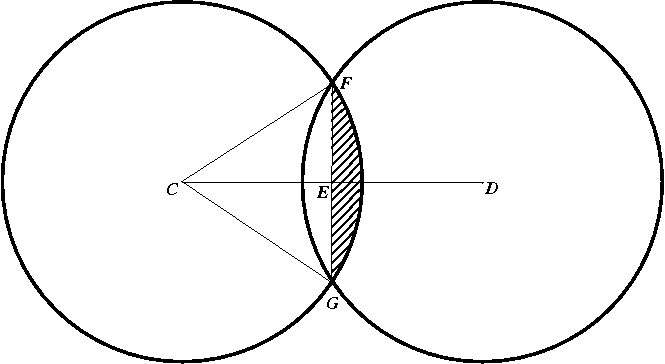
In this figure, C and
D are the centers of the two
circles of radius 1. If the length of CD is 2 or greater, there is no overlap. If
there is overlap, the area of overlap is twice the area of the
shaded portion of the figure. This area is called a
segment of a circle, meaning the area
bounded by a chord and the circle's perimeter. The CRC Standard Mathematical Tables gives this
formula for the area of the segment subtended by a given angle
θ.
Here R is 1 by definition, so
this formula simplifies to:
The angle θ is angle FCG
in the figure, which is twice angle FCE. We know that length CF is 1 because it is the radius of a unit
circle. We also know that length CE is exactly half of length CD. By simple trig, the cosine of angle
FCE is the adjacent side
(CE) divided by the hypotenuse,
which is 1. So, if S is the
separation between the circles in diameters, θ is given
by:
Now, on to the code. First, find the separation between the
two circles in terms of the standard circle diameter. This is
handled in Section 6.33, “CBCData.__circleSep(): Compute the
separation of two circles”. The result
is expressed in diameters, so a result of 1.0 or greater means
no overlap.
        #-- 1 --
        # [ sep  :=  separation between fromCircle and toCircle
        #            as a fraction of CIRCLE_DIAMETER ]
        sep = self.__circleSep ( fromCircle, toCircle )

        #-- 2 --
        if sep >= 1.0:
            return 0.0
The value of sep is the S in the formula above, so now we can compute
θ, then the area of the segment. The area of the
overlap is twice the area of the segment, which we then
convert to a percentage by multiplying by 100.
        #-- 3 --
        # [ theta  :=  angle subtending the segment where two
        #       unit circles overlap if their separation is
        #       (sep) diameters ]
        theta = 2.0 * math.acos(sep)

        #-- 4 --
        # [ overlapArea  :=  twice the area of the segment of a
        #       unit circle subtended by angle theta ]
        overlapArea = theta - math.sin(theta)
Finally, the percentage of overlap is computed as the area of the overlap, divided by the area of a unit circle, which is exactly π, and convert to a percentage by multiplying by 100.
        #-- 5 --
        return 100.0 * overlapArea / math.pi