pycbc: A Python interface to the Christmas Bird Count database |  |
pycbc: A Python interface to the Christmas Bird Count database | |
The previous database schema has been unchanged since 1998. This database currently exists as a MySQL database, and will provide the initial values for the current (Postgresql) version.
The initial setup of the Postgresql database proceeds in these steps.
The script described in Section 7, “The staticloader script: Populate
the static tables”
drops any existing tables, recreates the database, and then
populates the nations and regions tables.
Section 9, “transloader: Copy over the MySQL
database” describes the script that
populates the rest of the tables from the MySQL database.
The old MySQL database had
a very different structure, and was poorly normalized. In
particular, there was an unnecessary level of relation in
the stnd table, which mapped a key called
count ID to a circle, and three
other tables used the count ID to link to the stnd table, rather than directly to the circle
table. The count ID is a composite of two different
fields, and has two different formats depending on the
route the data took to get into the database originally:
| Count year | Count ID format |
|---|---|
001–090
|
|
091–present |
|
The YYY
The part of this key after the YYYyear_key column
of the efforts table.
Here, then, is an entity-relationship model for the old
database. The count ID is used as the key for all the
relations shown here, except that the relation from stnd to cir uses the lat_lon column.
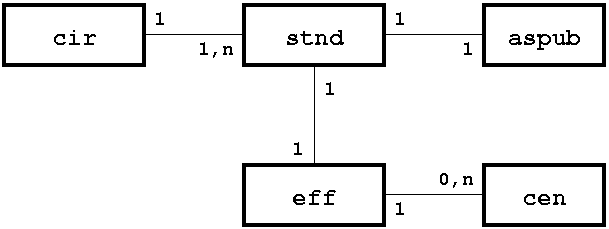
Note the two one-to-one relationships. There is one stnd row for each circle-year, and there is no
compelling reason to distribute the attributes of a
circle-year over two other tables (aspub and
eff). So, converting the old schema to the
new will lump the old stnd, aspub, and eff tables into the new
efforts table.
Refer to the 1998 database specification for a general description of the older schema. Here is a table showing the actual MySQL column names and types.
| Table name | Column name | Column type |
|---|---|---|
cir
| lat_lon | CHAR(9) |
physio | VARCHAR(4) | |
water | CHAR(1) | |
odd | CHAR(1) | |
regions | VARCHAR(6) | |
name | VARCHAR(80) | |
stnd
| lat_lon | CHAR(9) |
count_id | CHAR(8) | |
aspub
| count_id | CHAR(8) |
as_lat_lon | CHAR(9) | |
as_regions | VARCHAR(6) | |
as_name | VARCHAR(80) | |
eff
| count_id | CHAR(8) |
yyyymmdd | CHAR(8) | |
n_obs | INT | |
ph_tot | DECIMAL(5,1) | |
ph_foot | DECIMAL(5,1) | |
ph_car | DECIMAL(5,1) | |
ph_o | DECIMAL(5,1) | |
h_fd | DECIMAL(5,1) | |
h_owl | DECIMAL(5,1) | |
pm_tot | DECIMAL(5,1) | |
pm_f | DECIMAL(5,1) | |
pm_c | DECIMAL(5,1) | |
pm_o | DECIMAL(5,1) | |
m_owl | DECIMAL(5,1) | |
cen
| count_id | CHAR(8) |
seq_no | CHAR(3) | |
form | CHAR(6) | |
rel | CHAR(1) | |
alt_form | CHAR(6) | |
age | CHAR(1) | |
sex | CHAR(1) | |
plus | CHAR(1) | |
q | CHAR(1) | |
census | INT |