pycbc: A Python interface to the Christmas Bird Count database |  |
pycbc: A Python interface to the Christmas Bird Count database | |
The first step in redesigning the older database is to represent it as an entity-relationship model.
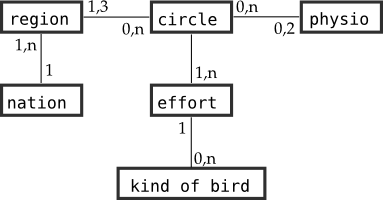
circle
Describes one 15-mile-diameter count circle by the latitude and longitude of its center.
region
One political region: a U.S. state, a Canadian province, or the only other nation represented in this database, the circle located on the French islands of Saint Pierre and Miquelon.
nation
One country.
physio
A physiographic region stratum code as defined by the U.S. Fish & Wildlife Service's Bird Banding Lab. For the authority file, see Section 2, “Downloadable files”. This code is useful for grouping circles by their biogeographic similarity. Many circle records have not been coded for physiographic strata. Circles may have up to two physiographic strata codes, and for those that have two, the first code is the major stratum and the second the minor stratum, so the ordering of the two codes is important.
effort
This entity describes one year in which there is a published census of the circle.
kind of bird
This entity represents a specific kind of bird seen in one
year, and the number of individuals of that kind that the
counters saw. Note that there may be many records for a
given species within one effort entity,
differing by several details: age; sex; whether seen count
day or only during count week; or whether the
identification is in question.
Note also that on a few occasions an effort has resulted in zero birds (mainly in remote parts of Alaska and Canada), but this is still considered a valid count.
The tables that represent the entities described above will carry the names of those entities, as plurals. Here are the attributes of these tables, and some discussion of how they are derived from the old database.
For the script that loads this table, see Section 7, “The staticloader script: Populate
the static tables”.
nation_code
Three-character code for the country.
nation_name
Full name of the country.
For the script that loads this table, see Section 7, “The staticloader script: Populate
the static tables”.
reg_nation
National code for this region, defined in Section 4.1.1, “Attributes of the nations table”.
reg_code
Two-character postal code, e.g., HI or YT.
reg_name
Conventional name of the region, e.g., “West Virginia” or “Province Quebec”.
lat
North latitude of the circle's center in degrees
and minutes as ddmm.
lon
West longitude of the circle's center in degrees
and minutes as dddmm.
water
Describes whether salt water occurs in the circle. This attribute is not always properly encoded, so the lack of a code does not imply a lack of salt water. Codes are:
| (blank) | Unknown or no salt water. |
p | Pelagic: the entire circle is in open ocean. |
o | Some open ocean is included in the circle. |
e | Some ocean estuary is included in the circle, but no open ocean. |
odd
Code to indicate an area that is not the standard
15-mile-diameter circle. As with the water attribute, not all circles were
properly encoded. Code values may be any of:
| (blank) | Standard circle or unknown shape. |
p | Pelagic-only transect. |
x | Not a pelagic-only transect, and not a standard circle. |
cir_name
The published name of the circle. Many circles
have changed their names; generally the attribute
in the circles table is the last
name used for that particular center. A few
standard abbreviations are used:
| M.A. | Management Area |
| N.M. | National Monument |
| N.P. | National Park |
| N.W.R. | National Wildlife Refuge |
| P.P. | Provincial Park |
| S.P. | State Park |
| W.M.A. | Wildlife Management Area |
physio_code
Two-digit code for the physiographic stratum, with left zero fill.
physio_name
Description of this physiographic stratum, e.g., “Southern Rockies”.
This table represents the many-to-many relation between circles and regions.
lat, lon
Link to the circles table.
reg_pos
Position of this region within the list of regions for the circle. This value is necessary because the regions are ordered. Values are 0 for the first or only region; 1 for the second region; 2 for the third region.
reg_code
Link to the regions table.
This table represents the many-to-many relation between circles and physiographic strata.
lat, lon
Link to the circles table.
physio_pos
Position of this stratum code: 0 for the first or only stratum, 1 for the second.
Each row of this table represents the censusing of one circle in a given year number.
lat
Latitude, encoded as in Section 4.1.3, “Attributes of the circles table”.
lon
Longitude, encoded as in Section 4.1.3, “Attributes of the circles table”.
year_no
The year number, three digits, with left zero
fill. For example, “043” for the Forty-third CBC (December 1942
and January 1943).
year_key
A five-character key that uniquely identifies an effort within a year. In particular, this field can help a researcher rapidly find the published data in the original periodical. See Section 3.5, “Year key” for a discussion of what actually appeared in the published data.
For year numbers 1–90, this column has format NNNNXNNNNX
For years 91 through the present, this column's format
always has the four-character SSKK
See Section 8, “Conversion from the old MySQL database” for more information about the origin of this field.
yyyymmdd
The date of the count, if known. For many records this is the date of Christmas because the true date was not recorded in the old database.
as_lat
Published latitude, if known. May be null.
as_lon
Published longitude, if known. May be null.
as_name
Circle name as published. The old database also tracked the region codes as published, but there is no strong reason to retain these data.
n_obs
Number of observers; an integer, one or greater.
ph_tot
This attribute and all the remaining attributes in this table may be null.
Total party-hours, to tenths.
ph_foot
Party-hours on foot.
ph_car
Party-hours by car.
ph_other
Party-hours by means other than foot or car.
h_fd
Hours (not party-hours) by feeder-watchers.
h_owl
Hours “owling” or, as it was later known, nocturnal birding.
pm_tot
Total party-miles, to tenths.
pm_other
Party-miles by means other than foot or car.
m_owl
Miles owling or other nocturnal birding.
lat
Latitude, encoded as in Section 4.1.3, “Attributes of the circles table”.
lon
Longitude, encoded as in Section 4.1.3, “Attributes of the circles table”.
year_no
The year number, encoded as in Section 4.1.7, “Attributes of the efforts table”.
seq_no
Sequence number of this record within the circle and year. Audubon chose to discard this field in their database, but it is vital to the Christmas Bird Count Database corrections project, because the records must be in the original order to be proofread efficiently against the original publication.
form
First or only form code describing the type of
bird. Example: AMEROB for
American Robin. These codes are defined in the
nomenclature system
specification.
rel
| (blank) | Not a species pair or hybrid. |
/ |
Species pair; the code for the second
alternative is in the alt_form attribute.
|
x |
Hybrid; the code for the second assumed
parent form is in the alt_form attribute.
|
alt_form
Second form code when the rel
attribute is not blank; null when rel is blank.
Because, for example, “Downy
Woodpecker/Hairy Woodpecker” is the same
kind of bird as “Hairy Woodpecker/Downy
Woodpecker”, the form codes are always
ordered such that, lexically, the form code is less than the alt_form code so that a given species
pair or hybrid will always have the same
representation.
age
Age code.
| (blank) | Unknown age class. |
a | Adult. |
i | Immature, subadult, or juvenal plumage. |
p | Female or immature. Yes, female is a sex and not an age class, but we arbitrary place this category under age. |
sex
Sex code.
| (blank) | Sex unknown. |
m | Male. |
f | Female. |
plus
Count-week indicator (see Section 3.7, “Count week birds”). Normally
blank; contains “+”
for count-week birds that were not seen count
day.
q
Questionable ID flag. Normally blank; contains
“q” if the editor
indicated some doubt as to whether this species
occurred in the circle at all. Records that are
in questions due to abnormally high numbers are
not flagged here.
census
Number of individuals. This is often encoded as
“-1” when the number
is unknown. Audubon's version of the database
uses zero when the number is unknown. For count
week birds, this attribute is generally -1, but a few such records contain
actual numbers.